The case for structured digital transformation with purpose

Transformation that works starts with a business problem, not a technology decision.
"Digital transformation" is one of the most overused phrases in business today. It has come to mean almost anything: a website redesign, a cloud migration, an AI pilot, a new ERP rollout. Which means it has also come to mean almost nothing. When every initiative is a transformation, the word loses its ability to describe what actually needs to change, and why.
The organisations we have seen execute transformation well share one characteristic. They start with a specific business problem, not a technology decision. The technology follows from a clear understanding of what the organisation is trying to change, for whom, and by what measure.
This article explains why so many transformations stall, and the three disciplines we use to keep them on track: structure before scale, the right sequence, and measurement that drives decisions.
Why most transformations stall
The failure modes are remarkably consistent:
- Scope creep. The initial problem was never defined precisely enough to resist additions, so every stakeholder's wish list finds its way in.
- Inverted sequencing. User-facing changes are delivered before the underlying systems that must support them are ready.
- Diverging expectations. The business case promised outcomes that the technical team did not realise they were being held to.
Beneath almost all of these sits a single root cause: the transformation was defined in technology terms rather than business terms. "Migrate to the cloud" is not a transformation goal. "Reduce time to market for new content from three weeks to three days" is.
The first cannot be measured or prioritised in any meaningful way. The second immediately raises useful questions: what is causing the delay today, and which of those causes can technology actually address? A few more examples of the same reframing:
| Defined in technology terms | Defined in business terms |
|---|---|
| Migrate to the cloud | Cut time to market for new content from three weeks to three days |
| Implement a new CRM | Give every account manager a complete customer view before each call |
| Launch a customer portal | Halve the number of support calls about order status |
| Roll out an AI pilot | Reduce manual invoice handling by a measurable share within two quarters |
| Replace the ERP | Close the monthly books in five days instead of twelve |
Examples are illustrative.
The right-hand column does not rule out the technology on the left. It simply makes the technology answer to something.
Structure before scale
The principle we use internally, and with clients, is that transformation should be structured before it is scaled. In practice that means three things:
- A clear outcome model. What will change, for whom, and how we will know. One primary measure, agreed by both business and technical leads.
- The smallest scope that produces a measurable signal. Not a minimum viable product for its own sake, but the narrowest slice of change that would move the outcome measure enough to see.
- The discipline to evaluate before expanding. A decision point at the end of each phase: continue, adjust or stop.
A phased approach is not a hedge. It is a mechanism for generating real evidence about what works before the organisation is committed to it at full scale. The first phase of a transformation is expensive not because of what it builds, but because of what it learns. That learning only has value if it is structured to produce decisions, not just reports.
Take the content example above. Rather than re-platforming every website at once, a first phase might target one high-volume content type on one site. If publishing time for that content drops from three weeks to a few days, the organisation has proof, a working pattern and a business case for the next phase. If it does not, it has learned that cheaply.
The sequencing question
Sequencing is where most well-intentioned transformation plans break down in execution. The natural tendency is to start with what is most visible: the customer-facing interface, the marketing site, the mobile app. The infrastructure and integration work those things depend on gets deferred.
This creates a compounding problem. The visible work creates expectations. The infrastructure work, which should have come first, now has to be delivered under pressure, without the time that careful architecture decisions need. Technical debt accumulates quickly in that gap.
The right sequence, almost universally, runs from the bottom up:
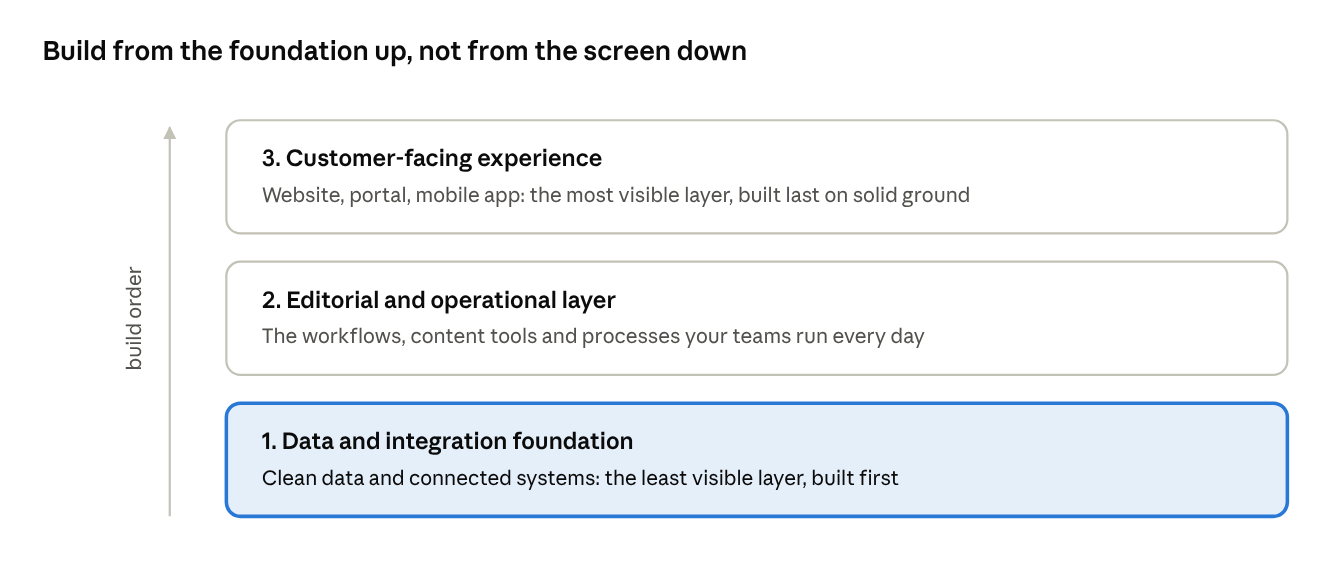
Establish the data and integration foundation first, then build the editorial and operational layer on top of it, and only then expose the customer-facing experience. This is slower at the start, and faster at every stage after it.
Measuring what matters
Transformation programmes succeed when the business outcome is specific enough to measure, and the measurement is taken seriously. Not as a reporting exercise, but as an input to decisions.
If the outcome measure is not moving in the expected direction, that is information. It should prompt a hard question about whether the scope of change is wrong, not simply an acceleration of the existing plan. A useful habit is to ask three questions at every phase review:
- Is the outcome measure moving, and by how much?
- If not, is the cause the scope, the sequence or the delivery?
- What would we stop doing if we were starting this phase today?
This requires a level of organisational discipline that is harder than any technical decision. It needs leaders who are willing to act on unflattering data, and teams who feel safe enough to surface it. Technology can support this discipline. It cannot substitute for it.
Transformation with purpose
The organisations that transform successfully are rarely the ones with the biggest budgets or the newest technology. They are the ones that define the problem in business terms, prove the change on a small scale, build in the right order and let real data shape every next step.
At Anchor Points, this is how we work. We help organisations of every size turn broad ambitions into specific, measurable outcomes, and deliver them in a sequence that builds momentum rather than technical debt. If you are planning a transformation, or trying to get a stalled one moving again, we would be glad to talk.