AI integration patterns for modern organisations

The organisations getting real value from AI are not the ones with the most advanced models. They are the ones that treated AI as a systems problem.
Every week brings a new model release, a new benchmark and a new headline about what AI can now do. It is easy to conclude that the path to value runs through picking the best model. In our experience building production AI integrations, it rarely does.
The organisations seeing consistent, measurable returns share something less glamorous. They invested in the conditions that let AI produce reliable outputs: clean and accessible data, well-defined workflows, and clear criteria for what a good result looks like. That holds whether you are a 20-person firm or a global enterprise.
This article sets out how we think about AI integration: the three patterns we see working in production, how to choose between them, and the three foundations that decide whether an AI project delivers or quietly stalls.
The model is rarely the constraint
When an AI initiative underperforms, the instinct is to blame the model and look for a better one. Swapping models is easy to propose and easy to measure, so it gets attention. But when we trace failures back to their source, the model is seldom where the problem started.
The usual culprits sit around the model, not inside it:
- The data it receives is incomplete, inconsistent or out of date.
- The workflow it plugs into was never clearly defined, so nobody agrees on what the AI is supposed to do.
- The success criteria were never written down, so nobody can tell whether it is working.
A stronger model fed with poor data, inside a vague process, with no way to measure results, will still disappoint. A capable but ordinary model inside a well-designed system will often outperform it. That is why we treat AI integration as an engineering and operations discipline first, and a model-selection exercise second.
Three integration patterns worth understanding
Organisations that move past experimentation into production AI tend to use one of three patterns. The difference between them is not how clever the AI is. It is where the human sits and what the human is responsible for.
1. Augmentation: AI assists, a person decides. The AI surfaces relevant information, flags anomalies or drafts a first version. A person reviews, edits and makes the final call. Think of a support agent who gets a suggested reply, or an analyst who gets a summary of 200 pages of contracts before reading the five clauses that matter.
2. Automation: AI executes, a person handles exceptions. The AI runs a complete workflow with defined inputs and outputs. People no longer review every result; they review the ones the system flags as uncertain or unusual. Think of document classification, data extraction from forms, or routing incoming requests to the right team.
3. Agentic: AI orchestrates, a person sets the goal. The AI plans and carries out multiple steps, calling tools and systems along the way. A person defines the objective and reviews the outcome rather than each step. Think of an assistant that researches a supplier, checks it against internal policy, drafts the onboarding paperwork and opens the right tickets.
| Augmentation | Automation | Agentic | |
|---|---|---|---|
| Who does the work | Person, with AI support | AI | AI, across several steps and tools |
| Where the human sits | Every decision | Exceptions only | Goal-setting and final review |
| Best suited to | Judgement-heavy, high-stakes tasks | High-volume, well-defined tasks | Multi-step tasks with clear goals and safe tools |
| Data readiness needed | Moderate | High | High, plus reliable system access |
| Main risk | Over-trusting suggestions | Silent errors at scale | Compounding errors across steps |
| Typical first win | Faster research and drafting | Lower cost per transaction | Hours of coordination work removed |
These are not stages of maturity. An organisation does not graduate from augmentation to agentic. Each pattern suits different tasks, risk tolerances and levels of data readiness, and a mature organisation usually runs all three side by side. Choosing the wrong pattern for a given workflow is one of the most common, and most costly, mistakes in AI integration.
One workflow, three patterns: an example
To make the distinction concrete, take a process almost every organisation runs: handling incoming supplier invoices. Here is how the same workflow looks under each pattern.
As augmentation. An accounts clerk opens each invoice. The AI pre-fills the vendor, amount, due date and cost centre, and highlights anything unusual, such as a price that differs from the purchase order. The clerk checks, corrects and approves. Every invoice still passes through a person, but each one takes a fraction of the time.
As automation. Invoices arrive by email and are processed end to end. The AI extracts the fields, matches them to purchase orders and posts them to the finance system. Only invoices that fail a check, or where the AI is not confident, land in a review queue. The clerk now spends their day on the 10 to 15 percent that need judgement, not the routine majority.
As agentic. A finance lead asks: "Resolve this month's unmatched invoices." The AI looks up each one, checks the purchase order system, emails the supplier for a missing reference, updates the record when the reply arrives and reports back with what it fixed and what still needs a decision.
All three are valid. The right one depends on the questions in the next section: how much variation the invoices have, how clean the purchase order data is, and how costly a mistake would be. Many organisations start with augmentation for a few weeks, use the corrections people make as evaluation data, and move to automation once the numbers justify it.
The percentages and steps above are illustrative; the real figures depend on your data and process.
Choosing the right pattern
The right pattern comes from the task, not from how ambitious the organisation wants to look. Three questions settle most cases.
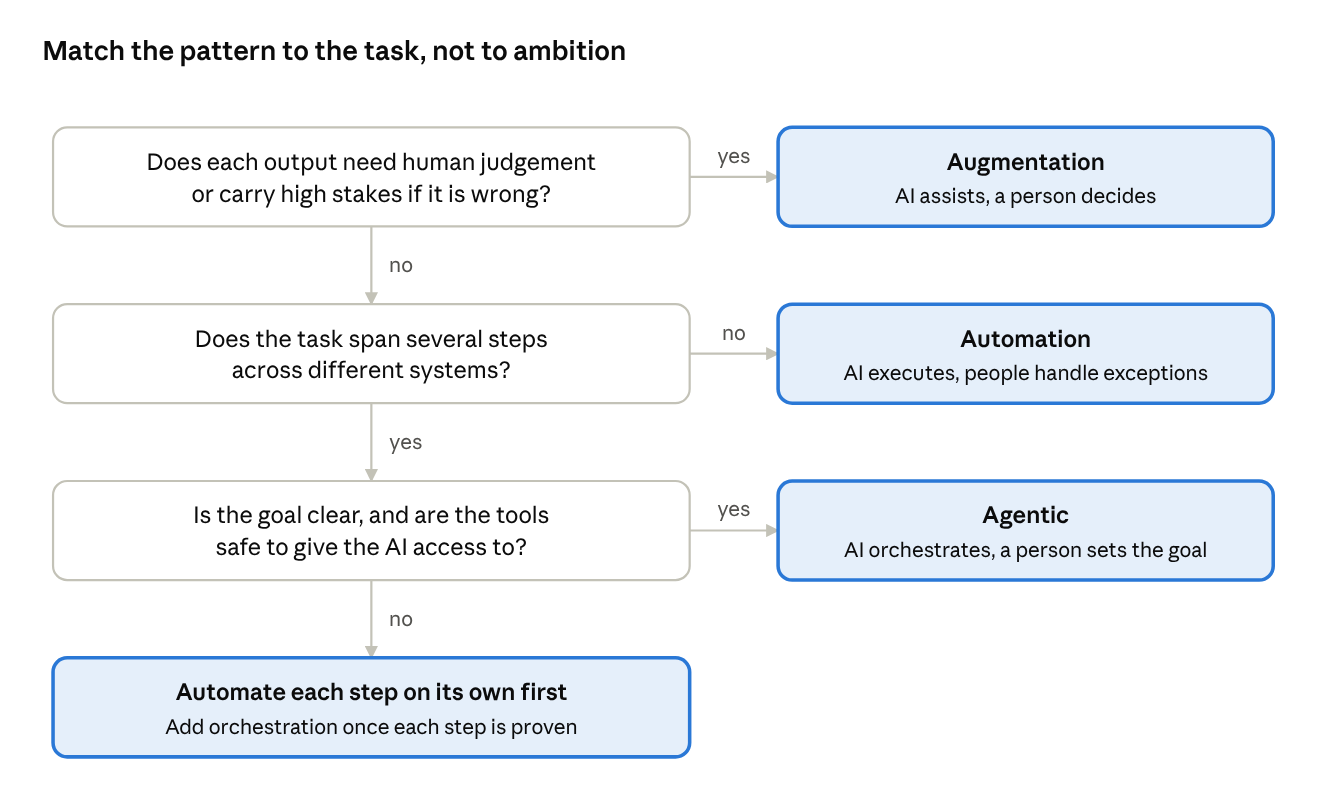
Read it top to bottom: judgement-heavy work stays with people, supported by AI; single-step, high-volume work suits automation; and only multi-step work with clear goals and safe tools is ready for an agent.
One question overrides all three: is the data ready? If the information the workflow depends on is scattered or unreliable, start with augmentation, whatever the diagram says. People will catch the errors, and their corrections become the evaluation data you need to move further. That brings us to the foundations.
Foundation 1: data readiness is the real prerequisite
AI systems are amplifiers. They amplify the quality of your data when it is good, and they amplify its problems when it is not. An organisation with fragmented, inconsistent or poorly governed data will not fix that by adding an AI layer. It will get fragmented, inconsistent and poorly governed AI outputs, only faster.
The good news is that the prerequisite work (data modelling, entity resolution, access governance, quality assurance) is often already partly done. In most organisations we work with, there is more data readiness than the team believes. It is simply spread across systems that do not talk to each other. A large part of making AI work is building the connective tissue between those systems, not buying new AI capabilities.
A quick self-assessment before any AI project:
If you can tick three or more, you are likely closer to production than you think. If you can tick fewer, that gap is where the first phase of work should go, and it will pay off well beyond AI.
Foundation 2: evaluation is not optional
The most consistent gap we see in AI projects is the lack of a defined evaluation framework before deployment. The pattern is familiar. A team builds a proof of concept, the results look reasonable to whoever reviews them, and it ships. Six months later, nobody can say with confidence whether it performs better than the process it replaced.
Evaluation has to be built in from the start. In practice that means four things:
- Define a good output before choosing a model. Write it down in plain language and, where possible, as something you can measure.
- Build a representative test set. Include typical cases and the awkward ones: incomplete inputs, unusual formats, ambiguous requests.
- Set a review cadence for production. Performance drifts as data, users and upstream systems change. Check it on a schedule, not only when someone complains.
- Be willing to act on the results. Including the possibility that the AI component is underperforming and should be redesigned, narrowed or switched off.
For the invoice example above, a simple evaluation scorecard might look like this:
| Measure | How it is checked | Example target |
|---|---|---|
| Field accuracy | Extracted values compared with a reviewed sample | 98% of fields correct |
| Straight-through rate | Share of invoices posted with no human touch | Rising month on month |
| Exception precision | Share of flagged invoices that truly needed review | Few false alarms |
| Cycle time | Hours from receipt to approval | Lower than the manual baseline |
| User corrections | Edits people make to AI output | Falling over time |
Targets are illustrative; set yours against your current baseline.
The point is not the specific numbers. It is that everyone agrees, before launch, on how success will be judged.
Foundation 3: operational safeguards are part of the design
AI in production needs safeguards that differ in kind from those for conventional software. Conventional software fails deterministically: the same input produces the same wrong output, so failures are reproducible and diagnosable. AI systems fail probabilistically. Failures can be intermittent, hard to reproduce and invisible until they have quietly piled up.
The safeguards that matter most:
- Confidence thresholds. Low-certainty outputs go to a person for review instead of triggering an automated action.
- Context-rich logging. Each decision is recorded with enough detail (input, output, model version, sources used) to diagnose a failure after the fact.
- Rate and scope limits. A model behaving unexpectedly cannot cause system-wide damage, because it can only act so often and only on what it is permitted to touch.
- A clear escalation path. When a user flags an output as wrong, it reaches someone who can fix it, and the case is fed back into the test set.
- A kill switch. Any automated or agentic flow can be paused instantly, with work falling back to the manual process.
These are engineering decisions, not AI decisions. They belong in the system design from day one, not bolted on after the first production incident. They also matter more as you move from augmentation towards agentic patterns, because fewer people are watching each individual step.
A practical path, whatever your size
You do not need a large AI team or a multi-year programme to start. The approach below works for a small business and scales to an enterprise; only the number of workflows changes.
- Pick one workflow that matters. Choose something frequent, measurable and painful today. Avoid starting with the most complex or most visible process.
- Map the data and the decision. Identify the systems involved, who makes the decision today, and what a correct outcome looks like.
- Choose the pattern deliberately. Use the questions above. When in doubt, start with augmentation: it is the safest way to collect real evaluation data.
- Define evaluation before you build. Agree the scorecard and assemble the test set first.
- Build with safeguards in place. Thresholds, logging, limits and an escalation path ship with version one.
- Measure, then expand. Once the numbers hold up, increase the AI's autonomy on that workflow or repeat the process on the next one.
Each cycle leaves behind reusable assets (connected data, an evaluation harness, monitoring), so the second and third integrations are faster and cheaper than the first. That compounding effect is where the real return on AI comes from.
The bottom line
The organisations that win with AI will not be the ones that chased every new model. They will be the ones that matched the right pattern to each workflow, prepared their data, agreed how success would be measured and designed for failure from the start.
None of this requires enterprise scale. It requires discipline, and a partner who has done it before.
At Anchor Points, this is the work we do. We help organisations of every size choose the right AI integration pattern, connect the data they already have, and put evaluation and safeguards in place so that AI delivers results you can measure. If you are planning your first AI integration, or trying to rescue one that has stalled, we would be glad to talk.