Building scalable platforms for enterprise growth

Scalable platforms are designed, not purchased.
Most platform scaling problems are not infrastructure problems. They are architecture problems that were deferred until the infrastructure could no longer absorb them. By the time a team reaches for more servers or a larger database, the structural decisions that made the system fragile have usually been in place for years.
That is the distinction we draw with every client, whether a growing business or a large organisation. The choices made in the first six months of a system's life decide what the platform can absorb three years later:
- how content and data are modelled
- how services communicate
- where state lives
- how integrations are structured
This article covers the principles we rely on to get those choices right: genuine decoupling, a broader definition of "scalable", infrastructure as code, and the one architectural decision that matters more than any other.
Decoupling is not an optional enhancement
The most consistent predictor of a platform's ability to scale is how genuinely decoupled its components are. That sounds obvious. Yet most platforms we are asked to modernise have presentation, business logic and data access tightly wound together, so that any single change is expensive and risky.
A headless CMS is a good illustration. Its real value is not delivering content to multiple channels. It is separating the editorial model from the delivery mechanism, so each can evolve on its own schedule:
- When the publishing team needs a new content type, they should not have to wait for a front-end release.
- When the API layer needs a performance improvement, it should not mean renegotiating content schemas.
- When the business wants a new channel, such as an app or a partner feed, it should plug into content that already exists.
This separation is structural work. It requires deliberate decisions about where the boundaries sit and what each layer is responsible for. It is hard to retrofit, which is why it needs to be established early and maintained with discipline.
What "scalable" actually means in practice
Scalability is usually framed as a capacity question: how many users can the system handle at once? That framing is too narrow. A platform that serves ten thousand concurrent users but needs a two-week release cycle for every content change is not scalable in the way that matters to the business.
We look at scalability across three dimensions:
| Dimension | The question it answers | Warning sign |
|---|---|---|
| Operational | Can the team maintain and extend the platform without bottlenecks? | Every change depends on one or two key people |
| Editorial | Can content and configuration change without engineering involvement? | Simple page or copy updates need a developer and a release |
| Technical | Can infrastructure grow or shrink without architectural rework? | More traffic means a redesign, not a setting change |
All three need attention. Organisations that optimise only for technical scalability often end up with systems that are fast, but slow and costly to run and change.
Infrastructure as code is not optional as you grow
One of the fastest ways to undermine a well-designed platform is to let infrastructure drift away from its documentation. As a platform grows, environments multiply: development, staging, user acceptance testing, production, regional variants. Manually managed infrastructure across all of them becomes a source of constant, low-grade instability.
Infrastructure as code addresses this directly. When environment configuration is version-controlled, reviewable and reproducible, the gap between what the system is documented to be and what it actually is disappears. The benefits are practical:
- Predictable deployments. Every environment is built the same way, every time.
- Faster recovery. After an incident, an environment can be rebuilt from code instead of from memory.
- Easier onboarding. New team members can understand the whole system without relying on tribal knowledge.
- Safer change. Infrastructure changes are reviewed like any other code before they go live.
The upfront investment in tooling and discipline usually pays for itself the first time something goes wrong. We have yet to work with a client who regretted it.
The decision that matters most
In our experience, the architectural decision with the highest long-term impact is where the integration layer sits.
Organisations that build integrations directly into their CMS or application code end up with systems where a change to one external service ripples across several codebases. Organisations that treat integration as a distinct concern, through an API gateway, a middleware layer or a well-defined event bus, can absorb vendor changes, service upgrades and new requirements without structural disruption.
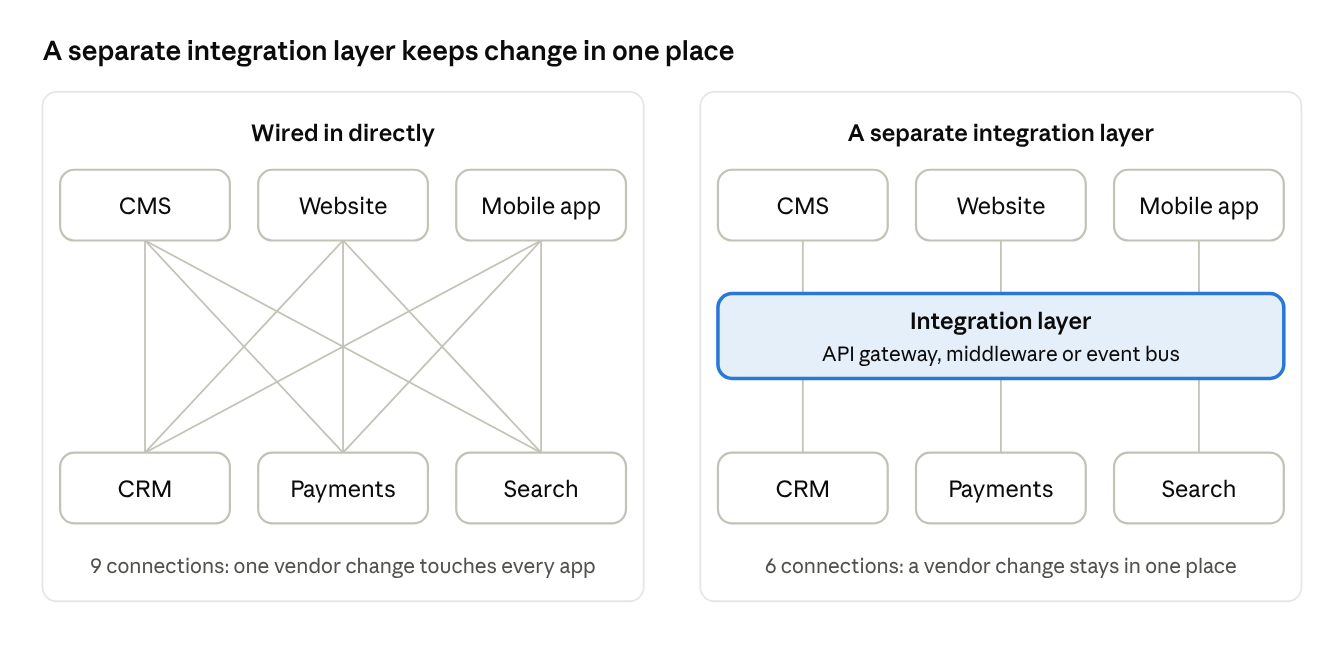
With three applications and three services, direct wiring already means nine connections to build, test and maintain. Each new application or service multiplies that number. With a separate layer, each system connects once, and replacing a vendor means changing one connection rather than every application that uses it.
This is unglamorous work. It does not produce visible features. But it is the difference between a platform the business can rely on for five years and one that needs a full rebuild in three.
Built to last
Scalable platforms are not the result of buying bigger infrastructure later. They come from a handful of disciplined decisions made early: clear boundaries between layers, a definition of scale that includes people and process, infrastructure managed as code, and integrations kept in their own layer.
At Anchor Points, this is the foundation we build on. Whether you are launching a new platform or modernising one that has started to strain, we help you make the architectural decisions that keep it fast, flexible and affordable to run as your business grows. We would be glad to talk.
Get in touch to book a short discovery conversation.