Web Design & Development Services That Drive Revenue: From Core Web Vitals to CRO
Revenue-focused websites win by pairing speed and clarity. This playbook shows how Core Web Vitals (LCP, INP, CLS) translate to measurable lift, why modern stacks + CDNs + smart image delivery cut load times, and how CRO discipline (heuristics → A/B tests) compounds gains. It also outlines analytics instrumentation (GA4 events, funnels, heatmaps), an implementation timeline with pricing tiers, and proof from public case studies. The goal is simple: faster pages, higher conversions.
Why speed + UX = revenue (Core Web Vitals explained simply)
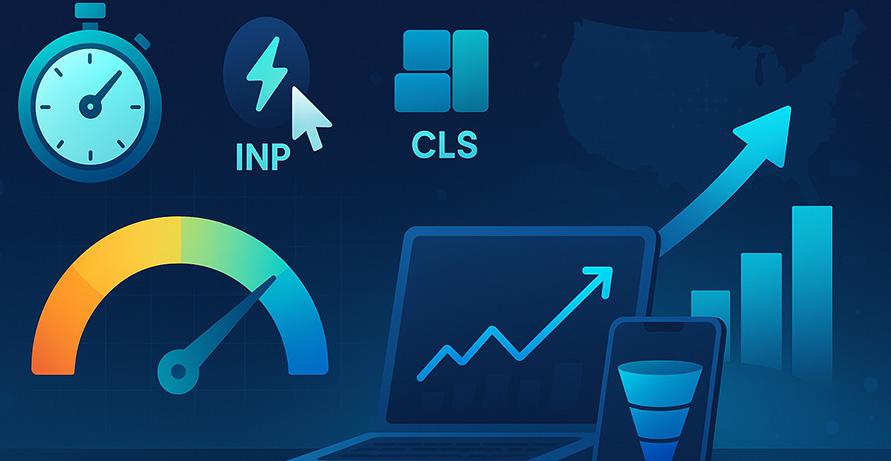
Core Web Vitals (CWV) focus on three real-user experience signals:
- LCP (Largest Contentful Paint) — perceived load speed; target ≤ 2.5s
- INP (Interaction to Next Paint) — input responsiveness; target ≤ 200ms
- CLS (Cumulative Layout Shift) — visual stability; target ≤ 0.1
INP replaced FID as a Core Web Vital on March 12, 2024, reflecting a stronger emphasis on end-to-end responsiveness.
Why this affects revenue:
- 53% of mobile visits abandon when load exceeds 3s—a stark reminder that slow equals invisible.
- A mere 0.1s speed gain has been tied to ~8–10% conversion lifts in retail/travel studies.
Author’s take: Speed is the only UX upgrade every user feels on every device. Treat CWV thresholds as SLOs for your site, not optional badges.
Our performance playbook (tech stack, CDNs, image strategy)
Architecture that ships less JavaScript
- Next.js/Remix for SSR/SSG and route-level splitting.
- Laravel with OPcache + HTTP caching for dynamic surfaces.
- Headless WordPress where editorial velocity matters without front-end bloat.
Edge delivery & caching
- Global CDNs (e.g., Cloudflare, Fastly, Akamai) reduce latency through edge caching and smarter prioritization, improving real-user speed.
Image strategy (often 50–70% of payload)
- Serve AVIF/WebP with responsive sizes & DPR variants; modern formats cut bytes and LCP.
- Mark the LCP image with
fetchpriority="high"and avoid lazy-loading it.
Critical-path hints
- Preload fonts/hero assets; use priority hints on true LCP candidates.
Guardrails in CI/CD
- Performance budgets (bundle size, LCP/INP regressions), Lighthouse CI, and field RUM checks prevent backsliding.
Author’s take: Most “slow” sites are asset-bound, not CPU-bound. Fix images and network priorities first; refactors come second.
CRO foundations (heuristics, A/B testing roadmap)
Heuristics before experiments
- Use the LIFT model (Value, Relevance, Clarity, Anxiety, Distraction, Urgency) to spot friction in hero sections, nav, pricing, forms, and PDPs.
A/B testing roadmap
- Instrument the money path (events, funnels).
- Prioritize with ICE/PIE scoring; run one clear hypothesis per test.
- Power & duration: plan for adequate samples; many tests won’t be winners—Optimizely reports ~10–20% win rates depending on metric.
- Iterate: keep validated changes, learn from nulls, and roll forward.
Author’s take: Speed removes friction; CRO shapes desire. The compounding effect comes from testing operationalized as a habit, not a campaign.
Analytics we set up (GA4, events, funnels, heatmaps)
GA4: recommended events + ecommerce/lead funnels
- Implement recommended events (e.g.,
view_item,add_to_cart,begin_checkout,purchase) and lead-gen events (form_start,form_submit,generate_lead) with parameters for item, price, campaign, and consent. - Ecommerce specs for web: enhanced product/impression tracking and checkout steps.
Behavior analytics (privacy-aware)
- Microsoft Clarity (free) for heatmaps/session replays; GDPR/CCPA-aligned with masking controls.
- Optional Hotjar tiers when research surveys/feedback are needed.
Author’s take: If it isn’t tracked, it didn’t happen. Tie funnels to CWV cohorts so you can see which pages lose money when they slow down.
Implementation timeline & pricing tiers
Indicative ranges for U.S. mid-market teams; final scope varies by stack and traffic.
1) Foundation — 2–3 weeks
- CWV/RUM audit and prioritized backlog
- Image CDN + AVIF/WebP rollout; font strategy & caching rules
- GA4 hardening (events, funnels), Clarity setup
- Outcome: quick LCP/CLS wins; CRO hypothesis backlog
2) Accelerate — 4–6 weeks
- SSR/SSG refactors (Next.js/Remix) or optimized WP/Laravel theme
fetchpriority, preloads, code-splitting; CDN rules for HTML & assets- First A/B tests (hero messaging/CTA & form friction)
- Outcome: “Good” CWV on top templates + first conclusive CRO readout
3) Scale — 6–10 weeks
- Headless or Laravel platform hardening; edge caching of HTML where safe
- Ongoing experiment program (2–4 tests/month) incl. server-side tests for performance changes
- CI performance budgets; field CWV dashboards
- Outcome: durable CVR lift and lower CPA
4) Care plan — monthly
- Experiment velocity, roadmap grooming, new template rollouts
- Regression monitoring, accessibility & micro-interaction improvements
Author’s take: The pattern is repeatable: fix LCP with images/CDN/priority hints, stabilize CLS with predictable components, then test messaging and form friction. Speed + clarity = revenue.
Final takeaways
- Make speed non-negotiable. Treat CWV as service-level objectives for your templates.
- Fix images & network first. AVIF/WebP + edge caching + priority hints deliver the fastest early wins.
- Operationalize CRO. Use LIFT to choose tests and expect ~10–20% win rates; consistency compounds returns.
- Instrument the money path. GA4 events/funnels plus heatmaps reveal where UX and CWV bottlenecks cost conversions. Google HelpMicrosoft Clarity
Book a free performance & CRO review. Get a CWV/RUM snapshot, a prioritized 30-day fix list, and a test roadmap tailored to your funnel.