The Hidden Cost of Skipping Software Design Specification (SDS)
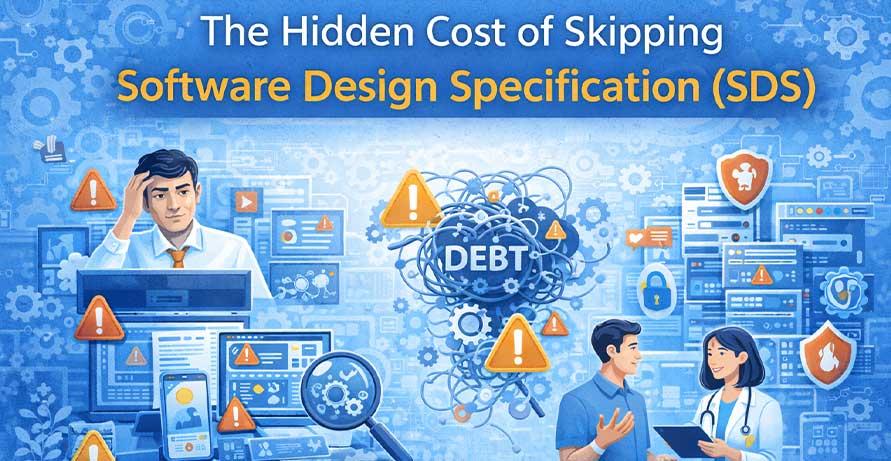
Software teams often skip Software Design Specification (SDS) to move faster. Delivery pressure, agile sprints, and tight deadlines push documentation to the bottom of the priority list.
In the short term, skipping SDS may seem efficient. In the long term, it creates technical debt, security risks, onboarding delays, and scalability problems.
This article explains the hidden enterprise costs of ignoring SDS and why structured design documentation is a strategic requirement, not an optional task.
What Is a Software Design Specification (SDS)?
A Software Design Specification defines how a system is built and why.
It typically documents:
- System architecture
- Component responsibilities
- Data flow and integrations
- Security controls
- Performance assumptions
- Non-functional requirements
SDS is not a static document. It is a living technical reference that supports long-term clarity.
Why SDS Often Gets Ignored
Modern development emphasizes speed and iteration.
Agile frameworks, CI/CD pipelines, and cloud-native tools allow teams to release features quickly. Documentation is often viewed as overhead.
This assumption is misleading.
SDS does not slow development. Poor documentation does.
Without SDS, teams rely on:
- Informal conversations
- Ticket comments
- Tribal knowledge
- Individual memory
Over time, this leads to confusion and rework.
The False Tradeoff Between Speed and Clarity
Many leaders believe documentation slows delivery.
In reality, unclear architecture causes:
- Repeated design debates
- Feature rework
- Misaligned implementations
- Delayed deployments
When architectural decisions are not recorded, teams revisit the same questions again and again.
Clarity improves delivery predictability.
How Anchor Points Helps
We implement lightweight SDS frameworks aligned with agile workflows. This preserves speed while improving architectural transparency.
Technical Debt Grows Faster Without SDS
Technical debt often comes from undocumented assumptions.
Without SDS:
- Dependencies remain hidden
- Integration patterns become inconsistent
- Duplicate logic appears
- Refactoring becomes risky
Maintenance costs increase because engineers must first understand the system before improving it.
Clear documentation reduces guesswork and long-term remediation costs.
Knowledge Loss and Team Dependency Risk
When SDS is missing, knowledge lives in people, not systems.
If key engineers leave:
- Architectural intent disappears
- Onboarding slows down
- New hires struggle to understand context
SDS reduces dependency on individuals and strengthens organizational resilience.
How Anchor Points Helps
We convert institutional knowledge into structured SDS documentation. This supports growth, restructuring, and team expansion.
Security and Compliance Risks Increase
Undocumented systems create security blind spots.
Security teams need visibility into:
- Data flows
- Trust boundaries
- Access controls
- Third-party integrations
Without SDS, risk assessments become reactive.
From a compliance perspective, documentation supports:
- Audit readiness
- Regulatory alignment
- Governance tracking
- Traceability of decisions
Organizations without SDS often scramble during audits.
Scalability Becomes Reactive
Systems built without documented design assumptions struggle under scale.
Common issues include:
- Performance bottlenecks
- Infrastructure misalignment
- Database overload
- Integration instability
Cloud migrations often expose undocumented dependencies.
SDS documents:
- Load assumptions
- Fault tolerance strategies
- Service boundaries
- Scaling expectations
Scalability should be intentional, not experimental.
The Long-Term Business Impact
Skipping SDS introduces slow, compounding costs:
- Higher maintenance budgets
- Slower feature delivery
- Increased security exposure
- Delayed onboarding
- Reduced innovation capacity
What appears to save time today creates operational friction tomorrow.
When Should SDS Be Created or Updated?
SDS should be reviewed during:
- Major feature releases
- Architectural changes
- Cloud migration initiatives
- Security reviews
- Compliance audits
- Platform modernization
Even legacy systems can benefit from reverse-engineered SDS documentation.
How Anchor Points Supports SDS Maturity
Anchor Points helps enterprises strengthen architectural governance through structured documentation practices.
Our approach includes:
- SDS audits and maturity assessments
- Reverse engineering legacy systems
- Architecture documentation frameworks
- Integration mapping
- Cloud-readiness analysis
- Ongoing governance support
We align system design clarity with long-term business objectives.
If your organization faces rising maintenance costs or onboarding delays, missing SDS may be the root cause.
Final Takeaways
Skipping Software Design Specification introduces hidden costs that grow over time.
Key points to remember:
- SDS improves architectural clarity
- It reduces technical debt
- It supports security and compliance
- It accelerates onboarding
- It enables predictable scalability
Speed without structure leads to long-term inefficiency.
Design clarity strengthens both agility and resilience.
FAQs
Q1. What is a Software Design Specification (SDS)?
It is a structured document that defines system architecture, data flow, integrations, and technical decisions.
Q2. Is SDS compatible with agile development?
Yes. Agile teams can maintain lightweight, evolving SDS documentation without slowing iteration.
Q3. Can SDS be created for legacy systems?
Yes. Reverse engineering and architecture analysis can generate SDS for existing platforms.
Q4. How often should SDS be updated?
During major releases, infrastructure changes, security updates, or compliance reviews.