Why Your Website Traffic Dropped After Redesign - Solutions That Work
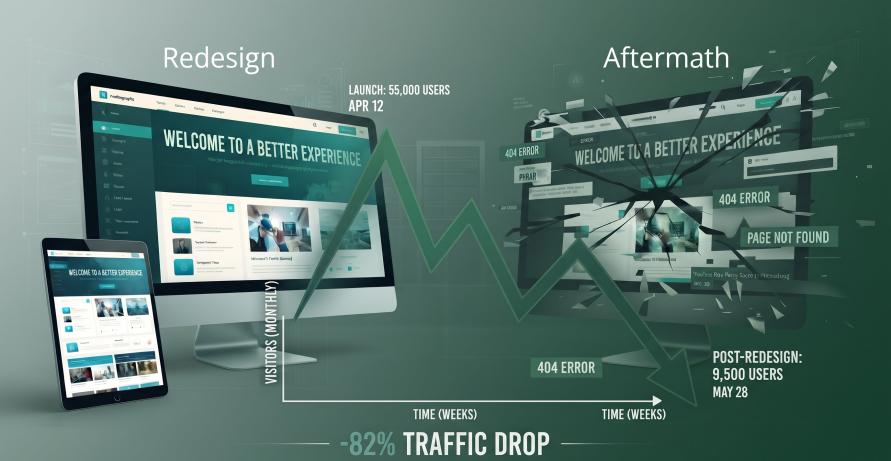
A redesign is supposed to improve your website, not damage your traffic. Yet many businesses experience an unexpected drop in visibility, rankings, and organic sessions shortly after launching a new site. This often happens because crucial SEO structures, technical settings, or content foundations were changed or removed during the redesign process.
This article explains the most common reasons traffic drops after a redesign and outlines proven strategies to recover. You will learn how to identify technical issues, restore SEO signals, and rebuild your site’s authority. Anchor Points helps companies diagnose redesign-related traffic losses and create a recovery roadmap that restores and strengthens organic performance.
The Truth: A Redesign Is Not Just a Visual Update
Most companies approach redesigns as branding or UI projects. The problem is that Google does not rank websites based on appearance. Rankings depend on technical foundations, content architecture, backlinks, structured data, and page performance.
When a redesign changes navigation, URLs, internal links, content structure, or code, Google must re evaluate everything. If the migration is not managed carefully, search engines lose trust in your site, causing temporary or long term traffic declines.
Anchor Points regularly fixes sites that lost traffic due to missing redirects, deleted content, slow new themes, or broken indexing settings.
Reason 1: URL Structure Changed Without Redirects
This is the number one cause of traffic loss.
If your redesign changed page URLs, removed blog links, or reorganized categories without proper 301 redirects, Google treats the old URLs as gone forever.
As a result:
- Rankings vanish
- Old backlinks lose power
- Pages become 404 errors
- Domain authority drops
How to Fix It
- Set up 301 redirects for every old URL
- Redirect at scale using mapping spreadsheets
- Test redirects with crawler tools
- Ensure redirects point to the most relevant pages
How Anchor Points Helps:
We perform redirect audits, rebuild lost URL equity, and restore technical signals that help Google understand your new site structure.
Reason 2: Important Content Was Removed or Shortened
Many redesigns cut content for aesthetic reasons. While the site may look cleaner, removing content also removes ranking signals.
Google ranks pages based on depth, relevance, and topical authority. If sections were shortened, merged, or deleted entirely, rankings drop because Google sees the new pages as less informative.
How to Fix It
- Restore high performing content
- Recreate missing keywords
- Add internal links to reclaim authority
- Expand blog posts and service pages with updated insights
Anchor Points uses content audits to identify which pages previously brought traffic and rebuilds them so they remain competitive.
Reason 3: The New Site Is Slower
Redesigns often introduce heavy themes, animations, large images, and unnecessary scripts. A slower website drastically reduces organic visibility because speed is a major ranking factor in Google’s Core Web Vitals.
Slow pages also frustrate visitors, increasing bounce rates and lowering engagement.
How to Fix It
- Compress images
- Remove unused JS and CSS
- Implement caching and CDNs
- Optimize hosting
- Improve code structure
- Fix layout shift and loading delays
Anchor Points performs speed optimization audits to rebuild fast, stable, and SEO friendly pages.
Reason 4: The New Design Broke Mobile Usability
A high percentage of U.S. search traffic happens on mobile devices. If your redesign introduced layout issues, tiny buttons, overlapping text, or slow mobile performance, Google reduces your rankings for poor usability.
How to Fix It
- Run mobile usability reports
- Fix spacing, tap targets, responsiveness
- Reduce heavy mobile elements
- Test across multiple devices
Anchor Points redesigns mobile layouts to ensure clean, fast, conversion friendly experiences across all screen sizes.
Reason 5: Meta Data and SEO Settings Were Reset
Many redesigns overwrite existing SEO titles, meta descriptions, alt tags, schema markup, and structured data. When these disappear, your pages lose relevance signals and CTR drops.
How to Fix It
- Restore all page titles and descriptions
- Add proper headings and alt text
- Reinstall structured data for services, products, blogs
- Re optimize pages using keyword intent
Anchor Points rebuilds SEO foundations using a structured approach that aligns content with search intent and ranking goals.
Reason 6: Your Website Stopped Getting Indexed
During redesigns, developers often use staging settings like noindex or disallow rules in robots.txt. When sites go live, these settings sometimes remain active, blocking Google from indexing the new pages.
How to Fix It
- Check robots.txt
- Remove noindex tags
- Resubmit your sitemap
- Use Search Console to request re indexing
Anchor Points verifies all indexing pathways during launch to ensure Google can crawl and rank your updated site.
Reason 7: The Information Architecture Changed Too Much
If you changed navigation, renamed categories, or reorganized site structure, Google needs time to relearn your hierarchy. Sudden changes confuse crawlers and dilute internal link strength.
How to Fix It
- Rebuild internal links
- Strengthen navigation structure
- Restore topic clusters
- Add breadcrumbs for clarity
- Simplify menus if necessary
Anchor Points creates structured, SEO driven navigation systems that help Google understand your content easily.
Reason 8: Backlink Equity Was Not Preserved
If top linked pages were deleted or redirected poorly, your site loses authority. Backlinks remain a strong ranking signal, and redesign errors often break them.
How to Fix It
- Identify lost backlinks
- Restore important pages
- Redirect broken links
- Update content for relevance
- Strengthen linkable assets
Anchor Points performs backlink audits and recovery processes to regain lost authority.
Reason 9: New Plugins or Themes Created Technical Issues
Poorly coded themes or conflicting plugins introduce errors like:
- Duplicate content
- Canonical conflicts
- JavaScript blocking
- Mixed content security issues
- Broken pagination
These issues directly affect how Google interprets your site.
How to Fix It
- Perform full technical audits
- Replace problematic plugins
- Validate code for compliance
- Fix canonical rules
Anchor Points handles deep technical debugging to restore site health.
Reason 10: No SEO Migration Plan Was Used
A redesign is a major technical shift, and without proper planning, SEO signals collapse. An SEO migration plan is essential for maintaining rankings and organic traffic.
How to Fix It
- Conduct pre launch SEO benchmarking
- Map all URLs
- Audit content
- Monitor post launch ranking movement
- Run site wide health checks
Anchor Points manages end to end SEO migrations to ensure smooth transitions and protect your search visibility.
Final Takeaways
A drop in traffic after redesign is common but fully fixable. The key is identifying the root cause quickly and restoring the technical and content signals that Google relies on. Most issues stem from missing redirects, removed content, speed regression, or broken SEO configuration.
When solved strategically, your website can recover traffic and even outperform your old site. A redesign should strengthen your digital presence, not weaken it.
How Anchor Points Supports You:
Anchor Points performs redesign recovery audits, technical fixes, SEO rebuilding, content restoration, and performance optimization. We help businesses recover lost rankings and strengthen long term visibility with structured, data driven improvements.
If your traffic dropped after a redesign, contact Anchor Points for a full recovery assessment and actionable plan to restore performance.
FAQs
Q1. How long does it take for traffic to recover after a redesign?
Recovery can take weeks to several months depending on the severity of issues and the speed of fixes.
Q2. Can traffic drop even if the redesign looks better?
Yes. Google ranks based on structure and performance, not visual design.
Q3. What is the first thing to check after a redesign?
Redirects, indexing settings, and missing content should be checked immediately.
Q4. Can lost rankings be fully restored?
Yes, as long as issues are fixed promptly and the domain had strong authority previously.
Q5. Does Anchor Points handle SEO migration planning?
Yes. We manage technical, content, and performance migration steps to ensure smooth transitions.