
University Website Requirements in the USA: FERPA and ADA Compliance Guide
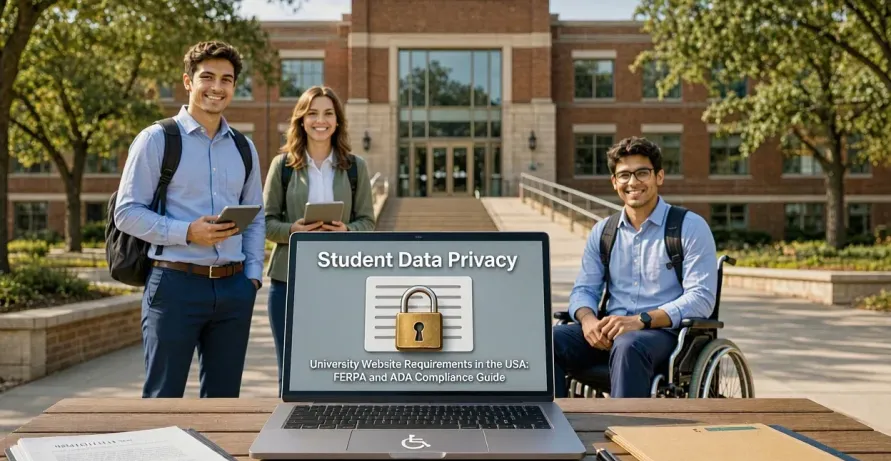
University websites in the United States function as regulated digital systems, not just marketing platforms. They must protect student data under FERPA and ensure equal digital access under ADA. Non-compliance can result in lawsuits, loss of federal funding, and reputational damage. This guide explains the technical, UX, and governance requirements universities must meet to stay compliant while delivering modern digital experiences.
Introduction: Why University Websites Are a Compliance Surface
Modern university websites support admissions, student portals, learning platforms, tuition payments, alumni services, and academic records. This makes them high-risk digital environments from both a privacy and accessibility perspective.
In the US, two federal mandates directly influence how higher education websites must be designed and operated:
- FERPA governs student data privacy and access control
- ADA mandates digital accessibility and equal access
Non-compliance exposes institutions to legal action, federal funding risks, and operational disruption. Increasingly, universities are shifting from design-only website upgrades to compliance-first digital transformations.
1. FERPA Requirements for University Websites
What FERPA Covers in Digital Systems
FERPA (Family Educational Rights and Privacy Act) regulates how institutions collect, store, access, and disclose student education records. Any university website or web application that processes personally identifiable student information falls under FERPA.
This includes:
- Student portals and dashboards
- Online grades, transcripts, and evaluations
- Financial aid and billing systems
- Admissions and enrollment platforms
FERPA requires strict access controls and safeguards to prevent unauthorized disclosure of student records.
Technical Best Practices for FERPA Compliance
FERPA-compliant university websites typically implement:
- Role-based access control for students, faculty, and staff
- Secure authentication, often with multi-factor authentication
- Encrypted data in transit and at rest
- Detailed audit logs tracking data access and changes
Many large universities separate public-facing CMS platforms from protected student systems using API-based integration layers.
Anchor Points Expert View
Most FERPA violations are not caused by external attacks. They result from weak architecture decisions, legacy CMS platforms, or improper permission models that expose sensitive data unintentionally.
How Anchor Points Helps
Anchor Points designs secure digital architectures that isolate public content from protected student data. Through custom web application development, identity management, and security audits, we help institutions reduce FERPA risk without compromising usability.
2. ADA and Digital Accessibility Obligations for Universities
ADA Requirements in the Digital Context
The Americans with Disabilities Act requires universities to provide equal access to digital services. Courts and the Department of Justice consistently interpret this requirement to include websites, portals, and online learning platforms.
Most US institutions align with WCAG 2.1 Level AA standards, which address accessibility for users with:
- Visual impairments
- Hearing impairments
- Motor disabilities
- Cognitive and learning differences
Lawsuits related to inaccessible admissions pages and online learning tools have increased sharply in recent years.
Accessibility Best Practices
ADA-compliant university websites include:
- Full keyboard navigation across all pages
- Semantic HTML for screen readers
- Proper color contrast and scalable typography
- Captions and transcripts for audio and video
- Accessible PDFs, forms, and interactive elements
High-profile cases involving elite universities have reinforced the need for proactive accessibility compliance.
Anchor Points Expert View
Accessibility failures are often invisible to internal teams. If a website has not been tested with assistive technologies, compliance gaps almost always exist.
How Anchor Points Helps
Anchor Points conducts accessibility audits, WCAG remediation, and accessible UX design. We embed accessibility into design systems and development workflows instead of treating it as a post-launch fix.
3. CMS, Portals, and Third-Party Tools: Hidden Compliance Risks
The Risk Landscape
Most university websites rely on a complex ecosystem of platforms:
- CMS systems for public content
- Learning management systems for academics
- Third-party tools for forms, payments, chat, and analytics
Even if the core website is compliant, a single inaccessible or insecure third-party integration can create FERPA or ADA violations.
Best Practices for Governance
Leading institutions now:
- Conduct vendor accessibility and privacy reviews
- Include WCAG and FERPA clauses in contracts
- Limit data exposure using secure APIs
- Perform routine compliance audits
Headless CMS architectures are increasingly used to improve governance and control.
Anchor Points Expert View
Compliance failures often occur at integration boundaries. Without clear ownership and technical governance, risk compounds silently.
How Anchor Points Helps
Anchor Points supports universities with CMS strategy, third-party risk assessment, and secure integration design. Our Drupal and WordPress engineering teams specialize in compliance-driven higher education platforms.
4. Performance, Reliability, and Compliance at Scale
Why Performance Is a Compliance Issue
Slow or unreliable websites disproportionately impact users with disabilities and those relying on assistive technologies. System failures during enrollment or exams can also create legal and operational risks.
Universities must ensure:
- High availability during peak traffic
- Fast load times for accessibility tools
- Secure, scalable hosting environments
Cloud-native infrastructure with monitoring and redundancy is now standard among compliance-focused institutions.
Anchor Points Expert View
Privacy and accessibility mean little if systems fail under load. Performance is a foundational compliance requirement.
How Anchor Points Helps
Anchor Points delivers performance engineering, DevOps, and secure hosting for higher education. We design systems that scale during admissions and registration without compromising accessibility or security.
Final Takeaways for University IT Leaders
- FERPA requires strict control over student data and access architecture
- ADA applies to all digital touchpoints, not just public-facing pages
- Third-party tools are a major compliance risk vector
- Accessibility and performance must be built into workflows
- Proactive audits reduce legal exposure and improve student experience
University websites are regulated systems, not just communication tools.
Anchor Points partners with universities to build secure, accessible, and compliant digital platforms.
If your institution is planning a website redesign, CMS migration, or portal upgrade, now is the time to address FERPA and ADA requirements properly.
👉 Schedule a higher education website compliance assessment
👉 Talk to our experts about FERPA and ADA-ready platforms
Frequently Asked Questions (FAQs)
1. Does FERPA apply to public university websites?
FERPA applies to any system that handles student education records, including portals linked from public websites.
2. Are private universities required to follow ADA digital accessibility rules?
Yes. Courts have ruled that ADA applies to both public and private higher education institutions.
3. What accessibility standard should universities follow?
Most US institutions follow WCAG 2.1 Level AA.
4. Can third-party tools cause compliance violations?
Yes. Embedded tools can introduce FERPA or ADA risks if not vetted.
5. How often should compliance audits be conducted?
At least annually and after any major redesign or system change.