How Serverless Web Applications Reduce Infrastructure Complexity
Infrastructure management has traditionally been one of the most resource-intensive and technically demanding aspects of building modern web applications. Engineering teams must provision servers, configure environments, plan for peak traffic, implement failover strategies, monitor uptime, apply security patches, and constantly optimize performance. As applications scale, this complexity multiplies, consuming valuable time and increasing operational costs. Serverless web applications fundamentally change this model by shifting infrastructure responsibility to cloud providers, allowing businesses to focus on innovation, product development, and customer value instead of server maintenance.
The Problem with Traditional Infrastructure
Traditional web applications rely on:
- Physical servers
- Virtual machines
- Load balancers
- Manual scaling rules
- Operating system management
Even in cloud environments, teams must still manage virtual infrastructure.
Common challenges include:
- Overprovisioning for peak traffic
- Paying for unused capacity
- Manual scaling adjustments
- Downtime during updates
- Ongoing patching and maintenance
- Complex deployment pipelines
As traffic grows, complexity increases.
What Is a Serverless Web Application?
A serverless web application runs on managed cloud services.
Developers write code. The cloud provider manages the servers.
Popular serverless platforms include:
- AWS Lambda
- Azure Functions
- Google Cloud Functions
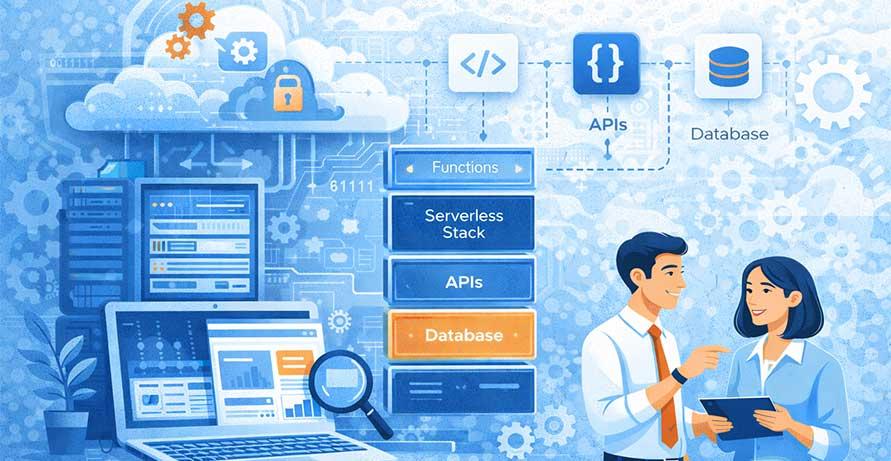
A typical serverless architecture includes:
- Cloud functions for backend logic
- Managed databases
- API gateways
- Authentication services
- CDN-based content delivery
Servers still exist, but your team does not manage them.
1️⃣ Automatic Scaling Removes Capacity Planning
Capacity planning is one of the biggest infrastructure headaches.
Traditional systems require teams to predict traffic and allocate resources manually.
Serverless platforms scale automatically:
- Traffic increases → resources scale up
- Traffic decreases → resources scale down
No manual intervention is required.
This eliminates:
- Emergency scaling
- Load balancer tuning
- Idle server costs
Your application remains responsive during traffic spikes.
2️⃣ Reduced Operational Overhead
Server maintenance consumes engineering time.
Traditional infrastructure requires:
- OS patching
- Runtime updates
- Security fixes
- Server monitoring
- Hardware upgrades
Serverless platforms handle all of this automatically.
Your team focuses on:
- Business logic
- Product features
- Customer experience
This improves development speed and reduces DevOps burden.
3️⃣ Faster Deployment and Continuous Delivery
Serverless architecture supports smaller, independent functions.
This enables:
- Faster deployments
- Safer releases
- Easier rollbacks
- Reduced risk of system-wide failure
Instead of deploying an entire application, teams deploy small function updates.
This improves agility and supports CI/CD pipelines.
4️⃣ Built-In High Availability
High availability usually requires:
- Redundant servers
- Multi-region failover
- Complex monitoring systems
Serverless platforms provide built-in availability across multiple zones.
This reduces architectural complexity while improving reliability.
Downtime risk decreases significantly.
5️⃣ Pay-As-You-Go Cost Model
Traditional infrastructure charges for:
- Reserved servers
- Idle resources
- Fixed hosting capacity
Serverless pricing is usage-based.
You pay for:
- Execution time
- Number of requests
- Actual compute usage
Benefits include:
- No idle costs
- Lower upfront investment
- Better cost alignment with demand
For variable workloads, serverless often reduces total infrastructure cost.
6️⃣ Improved Security with Smaller Attack Surface
Managing servers increases security exposure.
Serverless reduces risk by:
- Eliminating direct server access
- Using isolated execution environments
- Enforcing fine-grained IAM policies
- Centralizing identity management
Security is embedded into the cloud provider’s architecture.
Less infrastructure means fewer vulnerabilities.
When Serverless Makes the Most Sense
Serverless is ideal for:
- APIs and backend services
- Event-driven applications
- SaaS platforms
- Applications with unpredictable traffic
- Microservices architecture
- Rapid product development
Hybrid architectures are also common. Some systems combine serverless with traditional infrastructure.
Real-World Example
A SaaS company migrated from a VM-based architecture to serverless.
Before migration:
- Manual scaling
- High maintenance effort
- Frequent deployment delays
- Unpredictable costs
After migration:
- Infrastructure management dropped significantly
- Deployment frequency increased
- Reliability improved
- Costs aligned with actual usage
Engineering teams focused more on innovation instead of maintenance.
Common Mistakes to Avoid
Serverless adoption should be strategic.
Avoid:
- Migrating without architectural redesign
- Ignoring cost monitoring
- Using serverless for heavy constant workloads
- Poor logging and observability setup
- Lack of governance
Proper planning ensures successful implementation.
Why Businesses Choose Anchor Points
Anchor Points designs and implements serverless web applications that reduce operational complexity.
We specialize in:
- Serverless architecture design
- Cloud-native development
- Secure API integrations
- CI/CD pipelines
- Cost optimization
- Hybrid cloud solutions
- Ongoing monitoring and optimization
Our approach ensures:
- Scalable infrastructure
- Predictable performance
- Strong security
- Long-term cost efficiency
Final Takeaways
Serverless web applications simplify infrastructure management by:
- Eliminating server maintenance
- Automating scaling
- Supporting continuous deployment
- Reducing operational overhead
- Improving reliability
- Lowering cost for variable workloads
Serverless allows teams to focus on delivering value instead of managing infrastructure.
If infrastructure complexity is slowing down your development cycle, serverless architecture may be the solution.
FAQs
Q1. Does serverless mean there are no servers?
No. Servers still exist, but they are fully managed by the cloud provider.
Q2. Is serverless suitable for enterprise applications?
Yes. When designed correctly, serverless supports enterprise-scale workloads.
Q3. Can serverless reduce infrastructure costs?
Often yes, especially for applications with variable or unpredictable traffic.
Q4. Is serverless secure?
Yes. It reduces attack surface and supports fine-grained access controls.
Q5. How does Anchor Points approach serverless adoption?
We assess use cases, design scalable architecture, implement securely, and optimize continuously.